Surveyor’s dictionary – key terms and documents
Surveying is not only about field measurements, but also about many documents, decisions and specialized services that may sound foreign to those outside the industry. That’s why we’ve prepared a surveying dictionary that explains the most common terms in simple language. This will make it easier for you to understand what documents you need, when to use the services of a surveyor, and what formalities are involved in construction and investment.
1. glossary of geodetic documents
Map for design purposes
A special map prepared by a surveyor, necessary when designing a building or project. Used in the process of obtaining a building permit.
As-built map
A document created after construction, showing the actual location of facilities and installations. Required for building acceptance.
Principal map
A basic map of a given area, including utility networks, landforms and infrastructure elements.
Inventory map
Shows the boundaries of parcels of land and registered numbers. Basis for ownership issues.
Extract from the land register
A fragment of the registration map issued by the office – often needed for court cases or land divisions.
Extract from the land register
Official document confirming the owner of the land plot, area and land use.
Survey report
A summary of documents and measurements prepared by a surveyor – goes to the office as a basis for updating the data.
Official Clause
Confirmation that the surveying document has been accepted into the state resource and has the force of law.
2. glossary of surveying and surveying services
Building staking
Determination in the field of the place where the building is to be built, according to the project.
As-built inventory
Checking and plotting the actual routing of utilities, connections and buildings upon completion of the work.
Resumption of boundaries
Reconstruction in the field of the boundaries of the plot on the basis of official documentation.
Property demarcation
Proceedings to determine the disputed boundary between plots of land.
Division of the plot
Separate from one property several smaller ones – for example, for sale or investment.
Land consolidation
Reverse subdivision – combining several plots into one.
Situation and elevation surveys
Accurate determination of the location of objects and terrain.
Land leveling
Measurement of height differences in the terrain – useful for design and construction.
3. official (administrative and legal) glossary
Development conditions
A decision that determines what can be built on a site and how it can be built if a local plan is not in effect.
Local zoning plan (MPZP)
A municipality’s planning document that specifies the use of land (e.g., for development, services, greenery).
Decision on construction permit
Official authorization to begin construction.
Notification of construction works
A simpler procedure than a permit – used for smaller investments.
District Office / Department of Geodesy
The office where most surveying and construction matters are handled.
Geodetic and Cartographic Documentation Center (ODGiK)
The institution where official surveying records are kept.
4. glossary of modern geodesy and photogrammetry
Orthomosaics
An accurate photo of the area taken from a drone and processed so that it has the properties of a map.
Point cloud
A collection of millions of 3D points mapping the surface of an area or object.
3D terrain model (DTM/DSM)
Digital representation of terrain surface (DTM) or terrain with objects (DSM).
Measurements by drone
A state-of-the-art method for rapid and precise field data acquisition.
Camera calibration
Adjusting the drone’s camera parameters to increase the accuracy of measurements.
Georeferencing
The process of assigning geographic coordinates to photos or maps.
GSD (Ground Sampling Distance)
Field pixel size – the smaller the value, the more accurate the photo.
RTK / PPK
GPS technologies to improve surveying precision to centimeters.
5. technical glossary (for the construction industry and designers)
Building axis
A line marking the central position of an object.
Warp point
A fixed point in the field with precisely defined coordinates, used as a basis for measurements.
Height Reper
A reference point with a known elevation, used in leveling.
Coordinate system (e.g., PL-2000, PL-1992).
A reference system used in Poland to determine the location of points.
Map scale
Proportion of land mapping on the map.
Horizontal / vertical projection
The way an object is represented on a technical drawing.
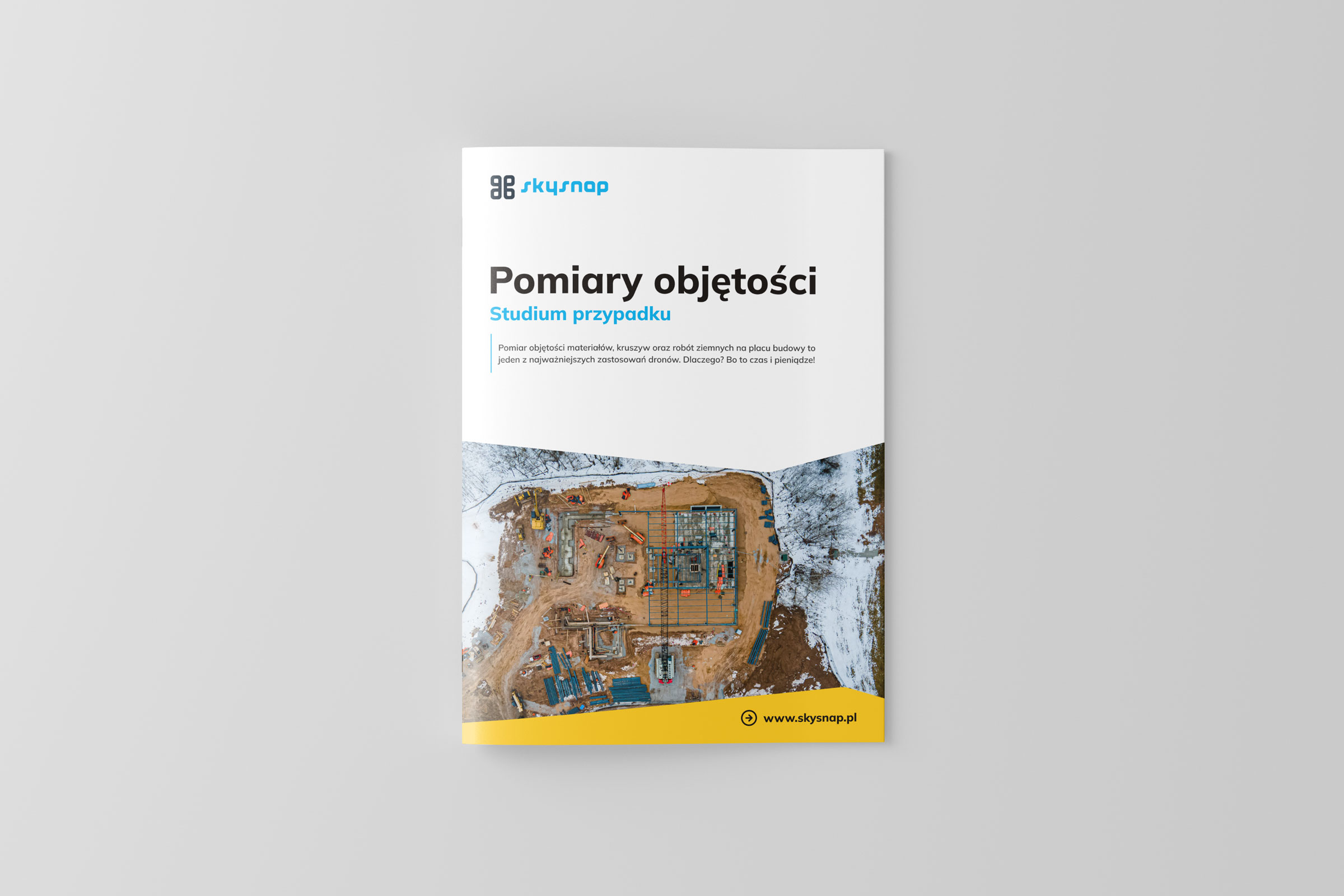
Free E-book
Measuring the volume of materials, aggregates and earthworks on a construction site is one of the most important uses of drones. Why? Because it’s time and money! Download our short e-book and learn how you can monetize your passion with drones.
Table of Contents
Tips, news, insights
Related articles
Check out our articles and get the latest industry news.