How are drones revolutionizing inventory management at companies?
Today, technology plays a key role in optimizing business processes, and one of the latest trends is the use of drones in inventory management. As companies strive to increase operational efficiency, drones are becoming an invaluable tool to quickly and accurately monitor inventory. With remote control capabilities and advanced camera systems, drones can reduce inventory time and minimize the risk of human error. In this article, we will look at how this modern technology is changing the approach to traditional inventory management, offering new perspectives on efficiency and savings.
Introduction to drone technology
Drone technology has evolved significantly over the years. Initially associated mainly with military applications, today they are widely used in various industries. In this section, we will look at the history and development of drones and their applications in business.
History and development of drones
Drones began their career as military tools, but over time they have found applications in many other fields. Their development dates back to the early 20th century, when the first experiments with unmanned aerial vehicles took place during World War I. After the end of the Cold War, drones began to be used for more commercial purposes.
Drone technology has developed rapidly in recent decades. The use of modern materials and advanced electronics has made it possible to create more robust and efficient units. Today, drones are used for everything from aerial photography to package delivery.
The growing popularity of drones in the civilian sector is a result of their ever-lower production costs and increasing availability. Today’s drones are equipped with advanced cameras, making them ideal tools for inspection and monitoring.
Drone applications in business
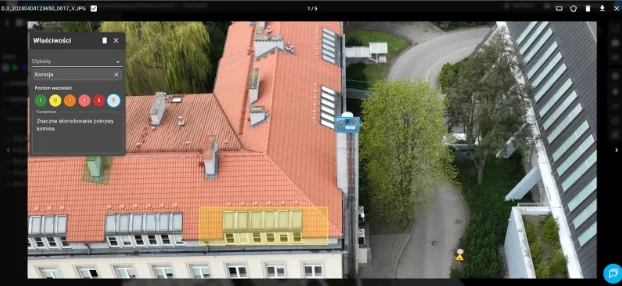
Drones are used in many business sectors. First of all, they are used for monitoring and inspection, which is extremely useful in industries such as construction and energy. They allow quick and efficient inspection of the technical condition of structures and installations.
In addition, drones are increasingly used in agriculture. They allow precise monitoring of crops and quick response to any problems. Agricultural drones can also conduct remote spraying, which is more efficient than traditional methods.
In the logistics industry, drones are gaining popularity as a tool for warehouse management. They help automate processes, such as inventory, and monitor inventory in real time.
Benefits of drone use in inventory management
There are many benefits to using drones in inventory management. In this section, we’ll discuss how drones improve efficiency and accuracy, and how they help reduce operational costs for companies.
Increase efficiency and accuracy
Drones significantly improve the efficiency of warehouse management by automating inventory processes. Traditional inventory methods are labor-intensive and time-consuming, while drones can complete these tasks much faster.
The high accuracy of drones is another advantage. With advanced cameras and sensors, drones can identify and locate products with high precision, reducing the risk of human error. Automating these processes also allows for more frequent inventories, resulting in more up-to-date data.
With drones, companies can save time and resources, resulting in increased productivity. Warehouse employees can focus on more complex tasks, increasing overall operational efficiency.
Reduction of operating costs
Cost reduction is one of the most important benefits of using drones in warehouses. Drones eliminate the need for a large number of employees to manually manage inventory.
Operational costs are also reduced due to a reduction in inventory errors, limiting losses due to mismanagement of resources. Drones can operate continuously, which significantly increases the efficiency of logistics processes.
In addition, drones enable optimization of warehouse space. They allow companies to better manage the arrangement of goods, which allows them to use the available space more efficiently and reduce the costs associated with renting additional space.
Practical applications of drones in warehouses
Drones offer many practical applications in warehouses, the most important of which are inventory automation and real-time inventory monitoring. Here’s how these technologies work in practice.
Inventory automation
Drones can automate the inventory process, which is one of their most important applications in inventory management. With advanced navigation systems, drones are able to move quickly and accurately through the warehouse by scanning barcodes or RFID tags.
Automating inventory eliminates manual errors that can occur during traditional methods. Drones can operate at night or during hours when the warehouse is closed, which does not disrupt daily operations.
Speeding up the inventory process also saves time and resources. Companies can respond more quickly to changes in demand and adjust their orders to current market needs, making them more competitive.
Real-time inventory monitoring
Real-time inventory monitoring is another innovation that drones are bringing to warehouse management. With them, companies can get real-time information about the status of their inventory, which is crucial for effective logistics planning.
Drones equipped with the right sensors and cameras can transmit inventory level data directly to warehouse management systems. This allows for quick detection of shortages and excesses, which is essential for maintaining optimal inventory levels.
Storage conditions such as temperature or humidity can also be monitored in real time, which is especially important for sensitive products. In this way, drones help maintain the quality of goods and minimize the risk of loss.
Challenges and future of drones in logistics
Although drones offer many benefits, their implementation in logistics comes with some challenges. In this section, we will discuss technical and regulatory issues, as well as future innovations and prospects for drones in logistics.
Technical and regulatory issues
Technical problems are one of the main challenges of using drones in logistics. Drones can be prone to hardware failures or signal interference, which can lead to operational errors. It is therefore necessary to invest in their regular maintenance and software updates.
Regulations related to drone use can also be an obstacle. Many countries have strict drone regulations that restrict their use in public spaces. Companies must therefore comply with local regulations, which can be time-consuming and costly.
Data security is another aspect that needs attention. Drones collect and transmit large amounts of data, which carries the risk of violating privacy and confidentiality. Companies must therefore implement appropriate data protection measures.
Innovation and future prospects
Despite the challenges, the future of drones in logistics seems promising. Technological innovations are constantly expanding the capabilities of drones, making them even more efficient and versatile.
One development is the integration of drones with artificial intelligence (AI) systems. AI-equipped drones can learn and adapt to changing conditions, increasing their autonomy and precision.
Thanks to advances in battery and propulsion technology, future drones will be able to operate longer and more efficiently. This, in turn, will open up new applications, such as long-distance deliveries and inspections in hard-to-reach areas.
Success stories and case studies
In this section, we will present success stories and case studies with drone applications in various industries, such as food and automotive.
Food industry
In the food industry, drones are finding applications in supply chain management. For example, one major supermarket chain has introduced drones for inventory monitoring, which has significantly reduced inventory time.
- Improved accuracy in monitoring products with short shelf life.
- Optimize storage space with precise inventory management.
- Reduce waste by quickly identifying products that need to be sold.
By deploying drones, food companies can better manage their resources, resulting in better customer service and higher profits.
Automotive industry
In the automotive industry, drones are used to manage spare parts and components in large warehouses. With drones, automotive companies can quickly and accurately identify and locate needed parts.
- Reduce the time required to find specific components.
- Increasing the efficiency of logistics processes in complex warehouses.
- Minimize errors in locating and issuing parts.
Case studies show that integrating drones into warehouse processes allows automotive companies to optimize operations and increase their competitiveness in the market.

Free E-book
Measuring the volume of materials, aggregates and earthworks on a construction site is one of the most important uses of drones. Why? Because it’s time and money! Download our short e-book and learn how you can monetize your passion with drones.
Table of Contents:
Do you like the article? Share it with others!
Do you like the article? Share it with others!
Tips, news, insights
Related articles
Check out our articles and get the latest industry news.